I came back to Tokyo from Thailand with some Thai baht left in my wallet.
I just wanted cash, so I handed over 2,000 baht at Travelex in Yaesu. The rate was a total rip-off. I actually laughed.
A foreign-currency kiosk (SMART EXCHANGE) inside a 7-Eleven I found while walking was still better.
I didn’t check every shop around Tokyo Station, so this is just two actual rates — but it might help if you’re hunting for a desk near the station.
I also wondered if this was a one-off, or just how Tokyo exchange desks work. So I pulled the posted rates from the companies that publish them.
Back in Tokyo
Tokyo, first time in a while.
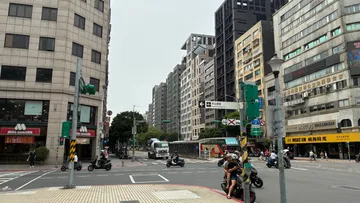
Walking past these buildings, around Tokyo Station, around the Imperial Palace — it actually feels like I came home.
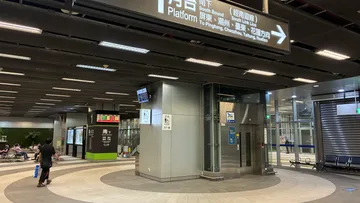
The photo is a construction site I snapped near the station. Sorry, I didn’t have a nicer one.
I’d just come back from Thailand with a bit of baht left, so I was walking around Yaesu looking to turn it into yen.
Yaesu Travelex: no fee, but a lousy rate
I only had 2,000 baht, so I casually exchanged it at the Travelex near a café in Yaechika (the Yaesu underground mall).
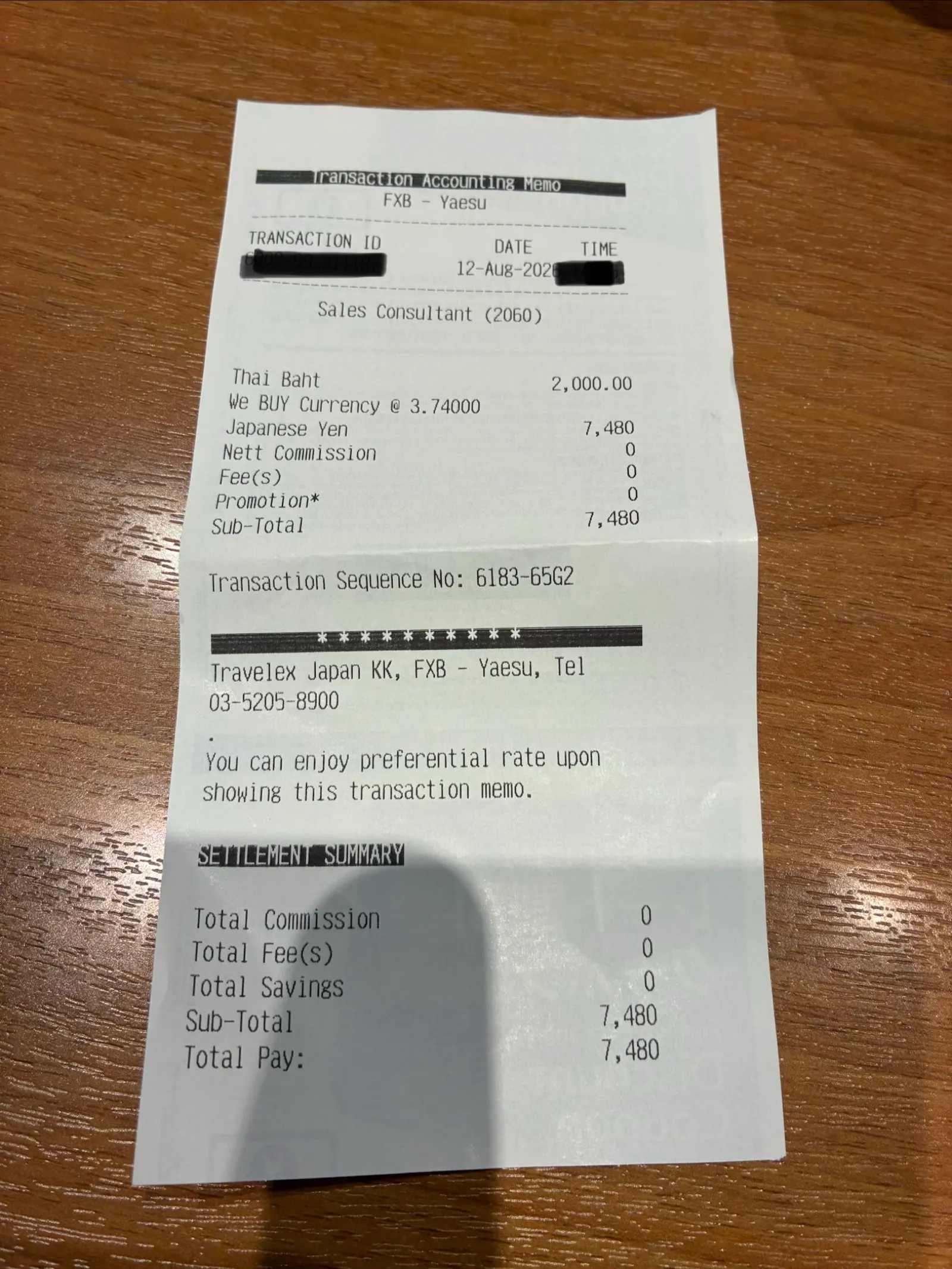
As the receipt shows, 2,000 baht came back as 7,480 yen.
(I didn’t even look at the rate. I figured it wouldn’t be that different, and just went through with it.)
That’s 3.74 yen per baht.
The fee is zero, but the rate itself…
Wise’s rate that day was about 4.81 yen per baht.
Same 2,000 baht would have been about 9,610 yen, so I left roughly 2,130 yen on the table.
I needed cash in a hurry, so I went ahead anyway.
It was still a terrible rate.
The 7-Eleven kiosk was still better
I was walking toward Shiodome, still annoyed, when I found a Smart Exchange kiosk inside a 7-Eleven around Shimbashi.
I’d seen these a lot when I lived in Osaka. Tokyo has them everywhere now too — maybe more tourists.
(They’re at most major stations, so you’ve probably walked past one.)
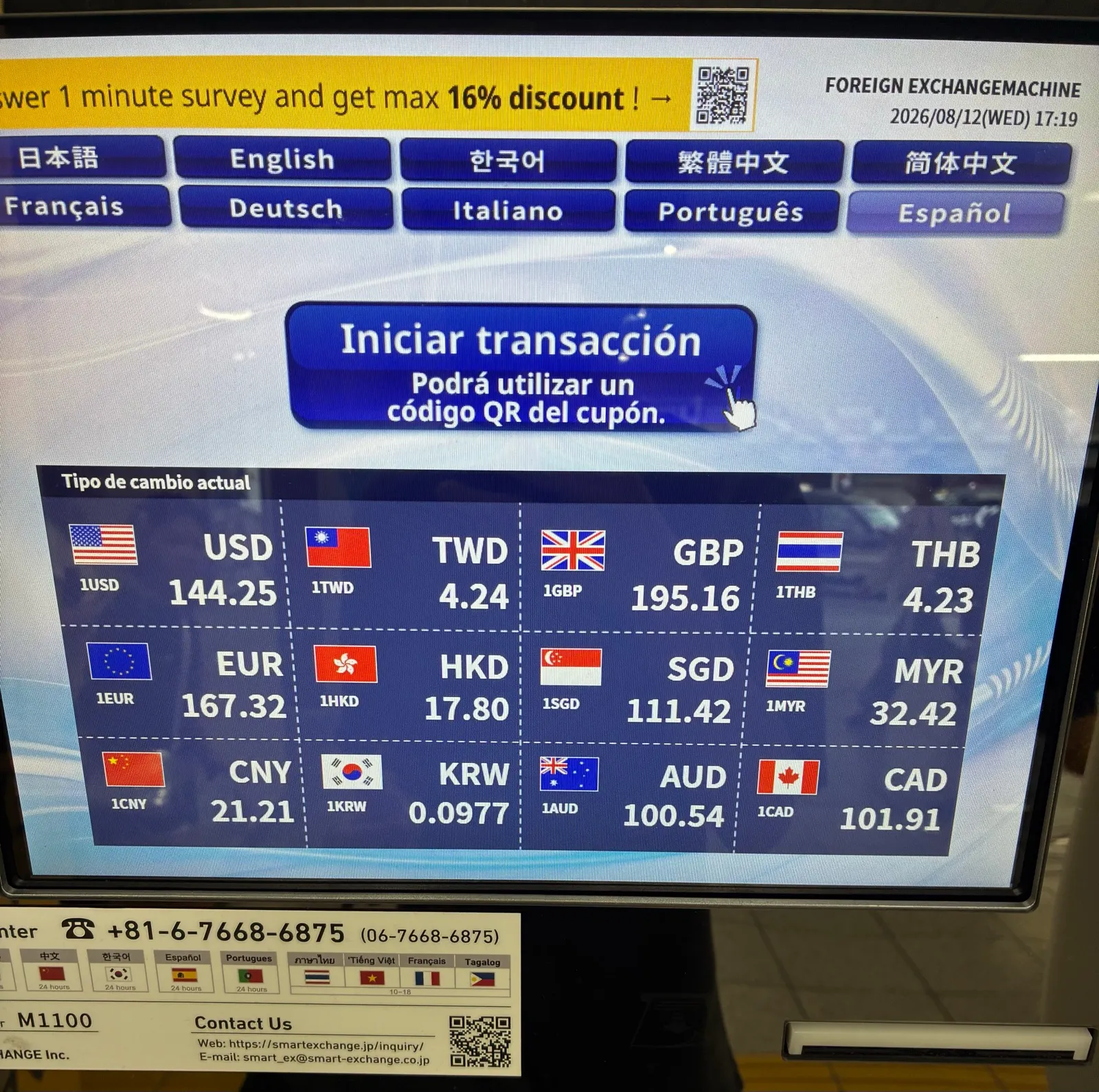
Thai baht was 4.23 yen.
Same 2,000 baht would be 8,460 yen — about 980 yen more than Travelex.
No extra fee. You just get the rate on the screen.
Still nowhere near Wise’s ~4.81 yen.
The same 2,000 baht against posted rates
I didn’t check other storefronts, so I went back and pulled the buy rates each company publishes.
It was a Sunday in Japan, so a lot of street desks were still sitting on Friday’s last update (14 August).
| Where | When | 1 baht | 2,000 baht |
|---|---|---|---|
| Yaesu Travelex (actual) | 2026-08-12 | 3.74 yen | 7,480 yen |
| Smart Exchange (actual / varies by machine) | 2026-08-12 | 4.23 yen | 8,460 yen |
| Travelex postal purchase (reference) | 2026-08-14 | 4.19 yen | 8,380 yen |
| World Currency Shop | 2026-08-14 | 4.28 yen | 8,560 yen |
| Narita GPA | 2026-08-14 | 4.30 yen | 8,600 yen |
| Kansai Airport (official counter) | 2026-08-14 | 4.39 yen | 8,780 yen |
| Doru Euro (online buyback) | 2026-08-16 | ~4.68 yen | ~9,370 yen |
| SuperRich 1965 (Silom Plaza) | 2026-08-16 | ~4.81 yen | ~9,615 yen |
| Wise mid-market (daily) | 2026-08-12 | ~4.81 yen | ~9,610 yen |
World Currency Shop’s official today’s rates (14 August 2026, 10:59) had a Thai baht buy rate of 4.28 yen.
Narita GPA’s official today’s rates (same day, 10:59) had foreign currency → yen at 4.30 yen.
Kansai Airport’s official today’s rates (14 August 2026) had a counter buy rate of 4.39 yen. Haneda’s official desk doesn’t publish a rate, so I left it out.
Travelex doesn’t show branch rates on the site, so I looked at the postal purchase reference rate. 4.19 yen as of 14 August.
As their FAQ says, online and in-store are different products.
Better than the 3.74 yen at Yaesu — still a bad rate.
Among the domestic posted numbers I could find, Doru Euro’s cash buyback looks pretty good.
As of 16 August, 4.684–4.693 yen depending on the amount band. Around 4.68 yen at the 2,000 baht size.
Bangkok’s SuperRich 1965, Silom Plaza shop on 16 August 2026, quoted 1 yen = 0.2080 baht if you were changing baht back into yen. That’s about 4.81 yen, basically mid-market.
Turning leftover baht into yen after you land in Japan looks worse than spending it locally, or getting just the yen you need while you’re still there.
You can pin the day’s rate on a board
I usually pull rates from the Wise API I use myself, and I built something you can embed on a blog: Currency Converter Board.
The board below is pinned to the same timestamp as the kiosk screen — 17:19 JST on 12 August 2026.
Amount is 2,000 baht, converted into yen, plus USD, EUR, and GBP while we’re here.
Wise’s public daily rate on 12 August was 1 baht = 4.80562 yen.
That’s about 9,610 yen. Against 7,480 yen in Yaesu, the gap is about 2,130 yen — a little over 20% below mid-market.
These aren’t locked-in quotes for sending or exchanging. Check the estimate in each service before you actually move money.
If you want a board like this, try the builder.
I wrote about how I made it in the Currency Converter Board intro.
Exchange locally, or take yen out with Wise
I didn’t walk the other desks in detail.
Looking at these numbers, though, turning leftover foreign cash back into yen at an airport or station after you land in Japan doesn’t look like a good deal.
In Thailand, SuperRich before you leave is still far better.
Same idea if you’re visiting Japan and need yen.
These days I’d rather put dollars or euros into a Wise account and take yen out of a Japanese ATM than hand notes to a walk-up booth. Cheaper and easier, most of the time.
On the way home, I’d rather spend the baht locally and withdraw yen in Japan when I need it, instead of carrying leftover notes.
Wise can’t take physical cash into the account, so leftover bills don’t go back in — but you can carry less cash.
Wise’s rate is cheap, but conversion itself has a separate fee.
The official blog for Japan-issued cards puts that around 0.73% as a rough guide.
It changes with currency and amount, so the app estimate is the one to trust.
On 2,000 baht, 0.73% would be around 70 yen.
ATM withdrawals with Wise are free as many times as you want, as long as you stay inside the monthly free allowance.
The size of that allowance depends on the country that issued the card.
Official fees: Japan-issued cards, free up to 25,000 yen a month.
After that, a 100 yen flat fee plus 1.75% of the amount over the cap.
UK-issued: free up to £250 a month, then 2.69%.
2,000 baht (about 9,600 yen) should fit the monthly free allowance on either a Japan-issued or UK-issued card.
Then there’s the ATM’s own fee.
That’s not Wise — that’s Japan Post Bank, the convenience store, and so on.
For overseas-issued cards, Japan Post Bank lists 220 yen per withdrawal including tax.
If I’d withdrawn the yen for this 2,000 baht inside the free allowance, at a machine with no ATM fee, the only hit would be about 70 yen for conversion.
Cash in hand around 9,500 yen. About 2,000 yen more than the 7,480 yen in Yaesu.
Even with a 220 yen machine fee on top, the gap is still large.
If you withdraw a lot of cash, the story shifts a bit.
Withdraw 100,000 yen on a Japan-issued card and the 75,000 yen above the 25,000 yen free allowance picks up 100 yen + 1.75% — about 1,410 yen on the Wise side alone.
Given that ~2,000 yen vanished on 2,000 baht at a walk-up desk, that’s still much better.
The free allowance doesn’t roll over. It resets at the start of the month.
The allowance is “free up to here,” not “you can’t withdraw more.”
Go over it and you just pay a fee. You can still take the cash out.
Separate from that: the card’s withdrawal limits.
There’s a daily cap and a monthly cap. You can see them on the card tab in the app.
If it’s too low, you can raise it yourself up to the maximum.
Japan-issued cards also have a per-transaction limit: one withdrawal can’t exceed 1 million yen.
Machines have their own caps too. Japan Post Bank lists 50,000 yen per withdrawal. On a day you need a lot, you split it or switch machines.
The official post says Japan-issued Wise cards are mostly limited to AEON, E-net (FamilyMart, etc.), and Daily Yamazaki.
Overseas-issued cards should be easier at ATMs with Visa or Mastercard marks (Seven Bank, Japan Post Bank, and so on).
If you’re visiting Japan with an overseas-issued card, you’ll probably have an easier time withdrawing.
If the ATM asks which currency you want, pick yen. Let the machine convert it and you lose Wise’s rate.
Fees also change with campaigns, currencies, and amounts, so get an estimate in the app before you use it.
To use Wise this way, you need an account and a card first.
If you don’t have one yet, you can open it from this referral link.
It’s a referral, so I may get a commission if you open an account. Existing Wise accounts aren’t eligible.
New users sometimes get a perk. (It changes by region and timing.)
In Japan, I think the first transfer fee is waived up to a certain amount.
There’s also stuff like transfer fees waived up to the equivalent of 75,000 yen.
Opening the account itself is free.
Paying with the card from a balance in the same currency doesn’t add a payment fee.
Even when you’re in a hurry, look at the rate once
This time, Travelex vs the kiosk was about 980 yen.
Against mid-market, about 2,130 yen. Small amount, but the gap just grows if you exchange more in one go.
On a day you need cash now, you want the nearest counter.
I walked in too.
Next time I’ll actually check the rate first.
If you’re coming to Japan from overseas, it might be safer to convert leftover cash at home — or in the country you’re leaving — if you don’t need to keep it.